
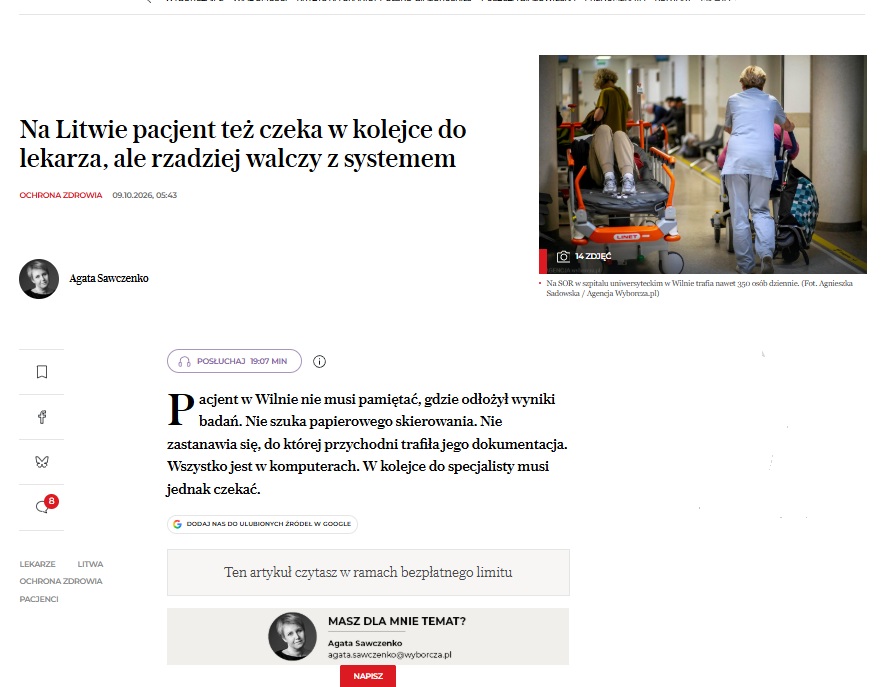
A publication about the Lithuanian health care system appeared in one of the largest Polish publications, Gazeta Wyborcza. In it, journalist Agata Sawczenko also paid considerable attention to the emergency medical service, which she visited together with her colleague.
The author of the article emphasizes that one of the most significant reforms of the Lithuanian health system in recent years did not start in hospitals or family doctors' offices, but in the emergency medical service.
Until recently, the Lithuanian ambulance system was divided into dozens of separate organizations. In different regions, different working principles were valid, ambulance equipment, salaries and service organization differed. As Karolis Klimavičius, head of the Competence Management and Methodology Department of the Lithuanian Ambulance Service, states in the article, "where 48 different standards used to operate, one is valid today."
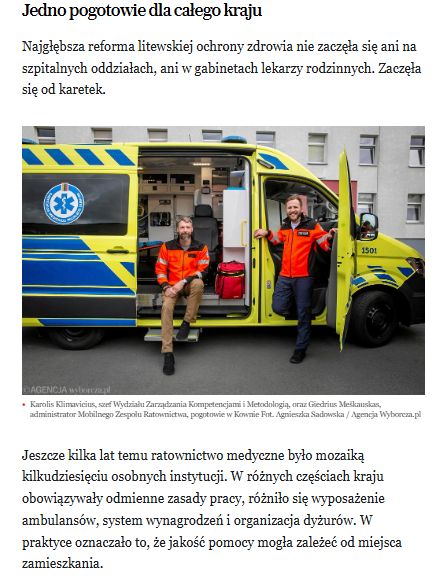
After the reform, employee training, procedures, car equipment and the salary system were unified. Klimavičius notes that previously the salary differences between some institutions reached as much as 30%, but now "there is one system in force throughout the country".
The article also draws attention to the work model applied in Lithuania. Contrary to what is still often imagined in society, the system is not based on doctors, but on paramedics and emergency nurses. "This is a model that most European countries use today," and doctors in crews usually only work in big cities.
Competitive remuneration also helps ensure the success of the reform. Giedrius Meškauskas, the administrator of the mobile ambulance team, explains that GMP employees earn more than a significant number of other public sector health care specialists, but this is mainly due not to higher basic salaries, but by night shifts, work on weekends and holidays.
According to the author of the article, it was the centralization of the emergency medical service that became an example of how consistent reforms can improve the quality of services throughout the country. Although Lithuania, like Poland, faces a shortage of doctors and growing needs for services, in the field of GMP it was possible to create a more coherent, clearer and more accessible system for the population.
Read the entire publication on the publication's website - The link is here.